Issue 16
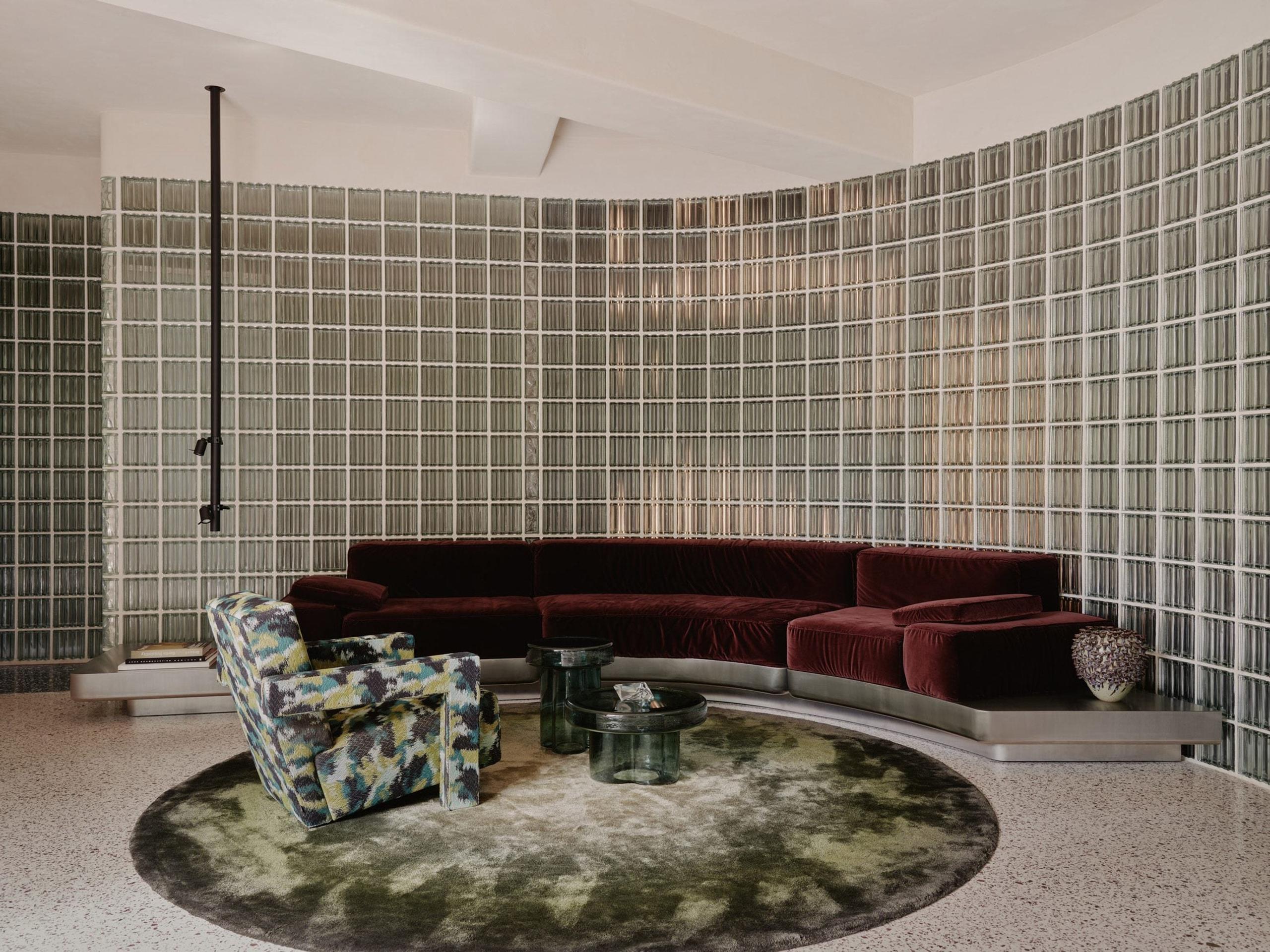
An apartment in Kreuzberg, Berlin, by Studio Karhard, published by Dezeen in January 2026. The crimson sofa is built around a curved glass-brick wall, and nothing in the room points at a screen.Photo: Robert Rieger, via Dezeen
The living room has stopped facing the television
3 November 2026 · Interiors & architecture · 7 min read · By Poppy Leverentz
Living room trends 2027, read from real rooms in Lidingö, Berlin and Cap Ferret. Seating sinks, the screen leaves the wall, and the room turns towards the people in it.
In a living room on Lidingö, just outside Stockholm, the television has been given its own room. The pattern and textile designer Cathy Nordström told Residence in October that the TV "absolutely must not be in the living room". Her family moved it next door, into a room with "basically just a big sofa, a bit of floor and a TV on the wall". (The Swedish quotes in this piece are my translations.)
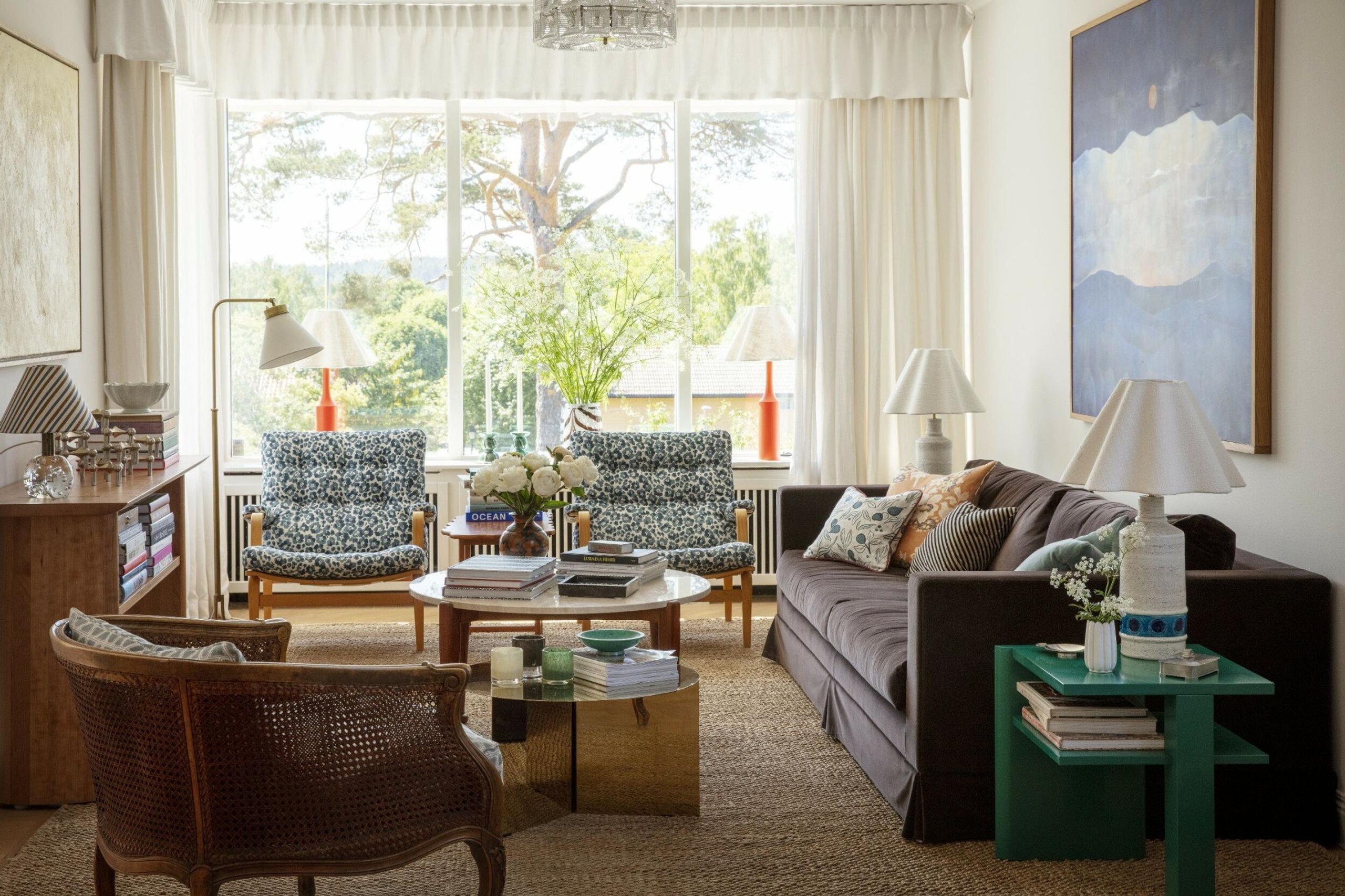
What is left in the living room is a big brown velvet sofa, armchairs, a large rug and a lot of small tables. The small tables are the detail I keep returning to. Nordström wants one within reach of every seat, so a cup or a glass can always be put down, wherever you happen to sit. "Nothing should be too far to reach," she said.
That is a room planned for people sitting a long time and talking. It sounds obvious. For about fifty years it was not how most living rooms were drawn.
The default plan put a screen on one wall and a sofa facing it, a few metres back, with a coffee table in between as a kind of no man's land. Nearly every living room trend for 2027 that I take seriously undoes part of that plan. The seating sinks and curls inward. The sofa leaves the wall. The screen goes behind a curtain or into another room. Books take the wall the television used to own. The colour drops to the floor.
The living room is turning around to face the people in it.
A conversation pit you can order online
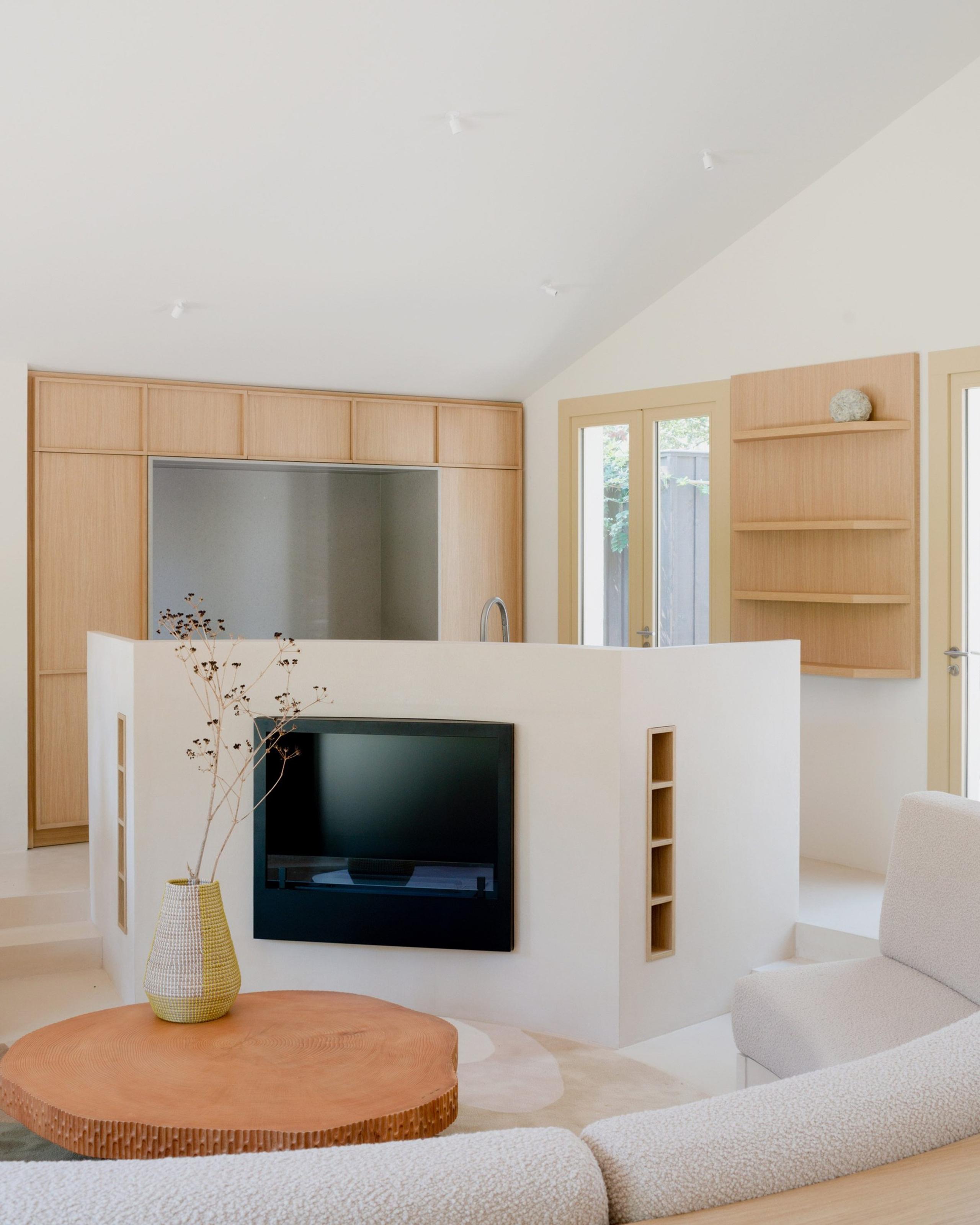
The clearest sign is the return of the conversation pit, and not only in architecture. In March, Dezeen published Seaside House, Studio Razavi's renovation of a 1930s cabin at the tip of the Cap Ferret headland near Bordeaux. The architects took out every central partition and sank a circular living room into the middle of the house, with the bedrooms around it.
"Sinking the living area was important so it would be clearly delineated without interrupting views across the building, from one facade to the other," the project architects Guillen Berniolles and Michele Sacchi told Dezeen. The low wall around the pit carries a sink and storage for the kitchen.
The version most people will actually live with is cheaper and softer. Omhu's Teddy, a modular corduroy sofa from Copenhagen with fat L-shaped back cushions and an external chrome frame, converts into a bed or a conversation pit. The company was founded four years ago and has sold more than 40,000 sofas. Its CEO, Simon Salomonsson, told Dezeen in October that the price sits at 1,500 or 1,600 euros. He was also candid about the foam inside it: "That'll never be the most sustainable thing in the world."
What a pit does is simple. Everyone faces inward, and nobody faces a wall.
The sofa comes off the wall
In Kreuzberg, Studio Karhard, the practice behind the interiors of Berghain, built a crimson, low-slung sofa around a curved glass-brick wall in an apartment for an American couple. It sits on a stainless steel base that turns into a side table at each end, and it wraps a velvety circular rug with petrol-green glass coffee tables on it. The whole room is a curve facing itself.
The manufacturers are moving the same way. Cattelan Italia added a curved module to Maurizio Manzoni's Craig sofa for Salone del Mobile, and Interior Daily wrote that it "enables the sofa to move away from the wall" and "encourages face-to-face interaction". In April ClassiCon launched Gabriel Tan's modular Soft Stone sofa: 11 modules partly modelled on Isamu Noguchi's 1970 sculpture Illusion of the Fifth Stone. "I wanted to capture the feeling of resting on something solid and monumental that nevertheless feels completely natural and soft," Tan said in its Dezeen Showroom listing.
Modules matter for a plain reason. A three-seater has a front and a back, and its back belongs against a wall. A set of modules can face two ways, close into a square, or split up when someone moves out.
Nordström's own rule is blunter. "The worst thing I know is a rock-hard, modern sofa that doesn't invite any kind of relaxation at all."
Behind a curtain, in a cabinet, on wheels
The television has not disappeared. It has lost its wall.
Residence put the same question to three interiors people, and none of them gave the screen the main wall. The stylist Malin Wahlström Walter, on Gotland, answered: "Behind textile, in a piece of furniture or on wheels. Flexibility is the key." The designer Erik Bratsberg is fine with the screen itself, now that it looks more like a picture frame. The cables and boxes are the problem, so he drilled through the wall and hid them in the room behind. Failing that, he said, he would have built the whole thing into a bookshelf.
In Rotterdam, Sabine Marcelis and the architect Paul Cournet use a projector. A 10-metre-wide, floor-to-ceiling curtain, printed with scans of the Berlin designer Ehsan Morshed Sefat's notebook pages, closes off the living area of their 500-square-metre loft when it runs. "I love that it's functional, blocking the light and creating a more intimate space when we have our projector on, but it's also an artwork in itself," Marcelis told Dezeen in June.
Bratsberg gave the reason better than any trend report I read this year. "Now that individual screens are outcompeting the togetherness of the TV, the living room is more important than ever," he told Residence. The shared screen used to be what pulled a family into one room. Phones broke that. A living room now has to do the pulling itself.
The television used to be the reason to come into the living room. Now the room has to be the reason.
Bookmaxxing, and other things worth facing
Take the screen off the main wall and something has to replace it. Mostly, it is books.
In June, Dezeen ran a lookbook on what it called "the tongue-in-cheek term bookmaxxing", used "to describe the current trend of showcasing books in a myriad of different ways". One of its examples is a book-lined oak nook with a small workspace in Studio Hagen Hall's Heion House in Islington. Marcelis's version is a wall of custom steel shelving by the Rotterdam designer Phil Proctor, directly opposite a squidgy, pit-style sofa.
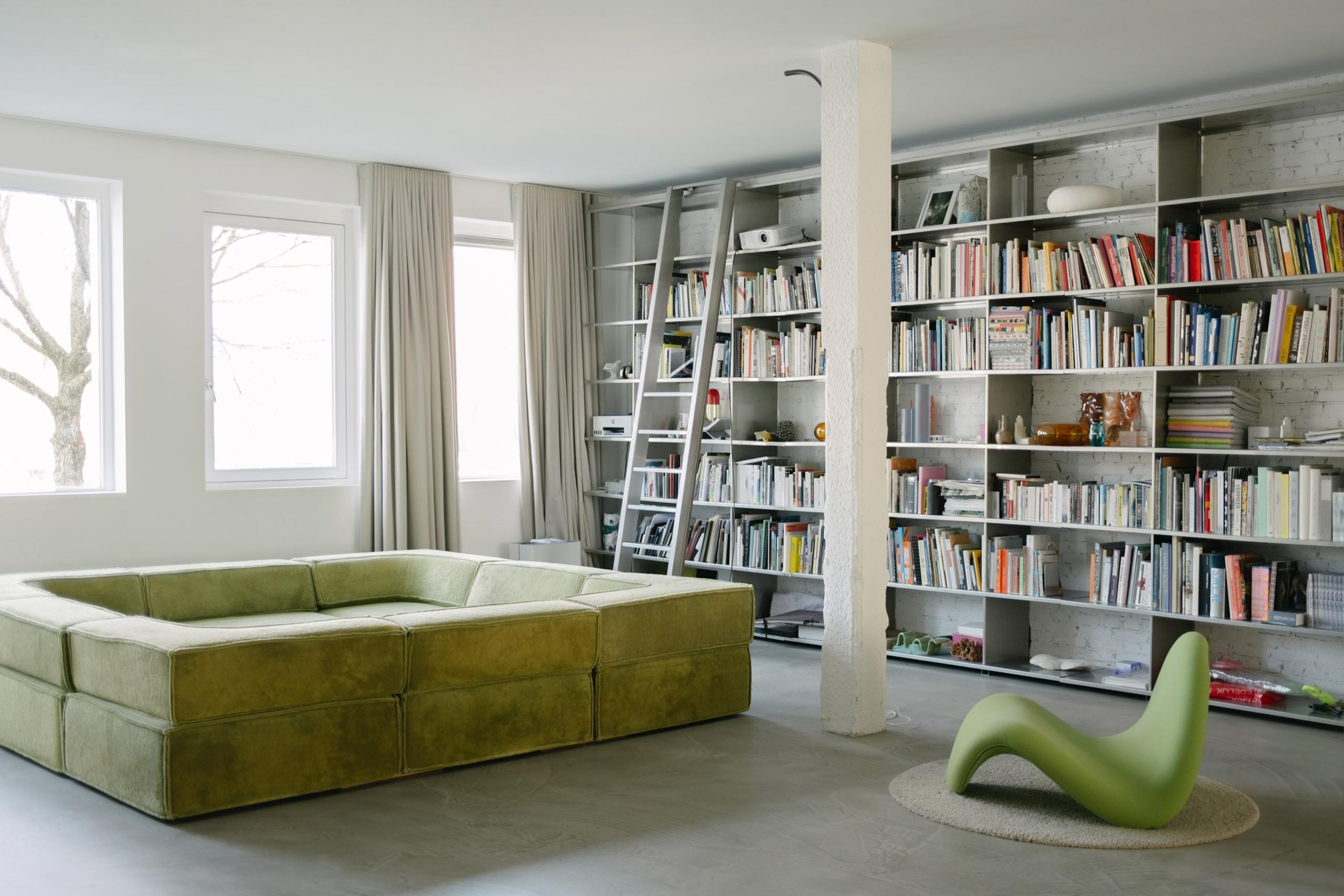
I read this less as a love of reading than as a love of evidence. Shelves of things a household has actually used say who lives there, which a black rectangle never did. Nordström asks for more of it, not less: "In with the small tables, the magazines, the books, the lamps, the little dishes and all the personal bits and pieces that make a place feel homely." Wahlström Walter tells clients to decorate with books and art rather than fragile vases, because nobody should have to be careful in the room they live in.
Colour moves down to the rug
Colour in these rooms sits low. Crimson velvet in Berlin. Brown velvet on Lidingö. A green pit in Rotterdam. Bratsberg says colour was the starting point for his own living room, partly to match an existing green tiled stove. The walls mostly stay quiet. Upholstery and floor carry the colour, which is where hands and feet actually meet the room.
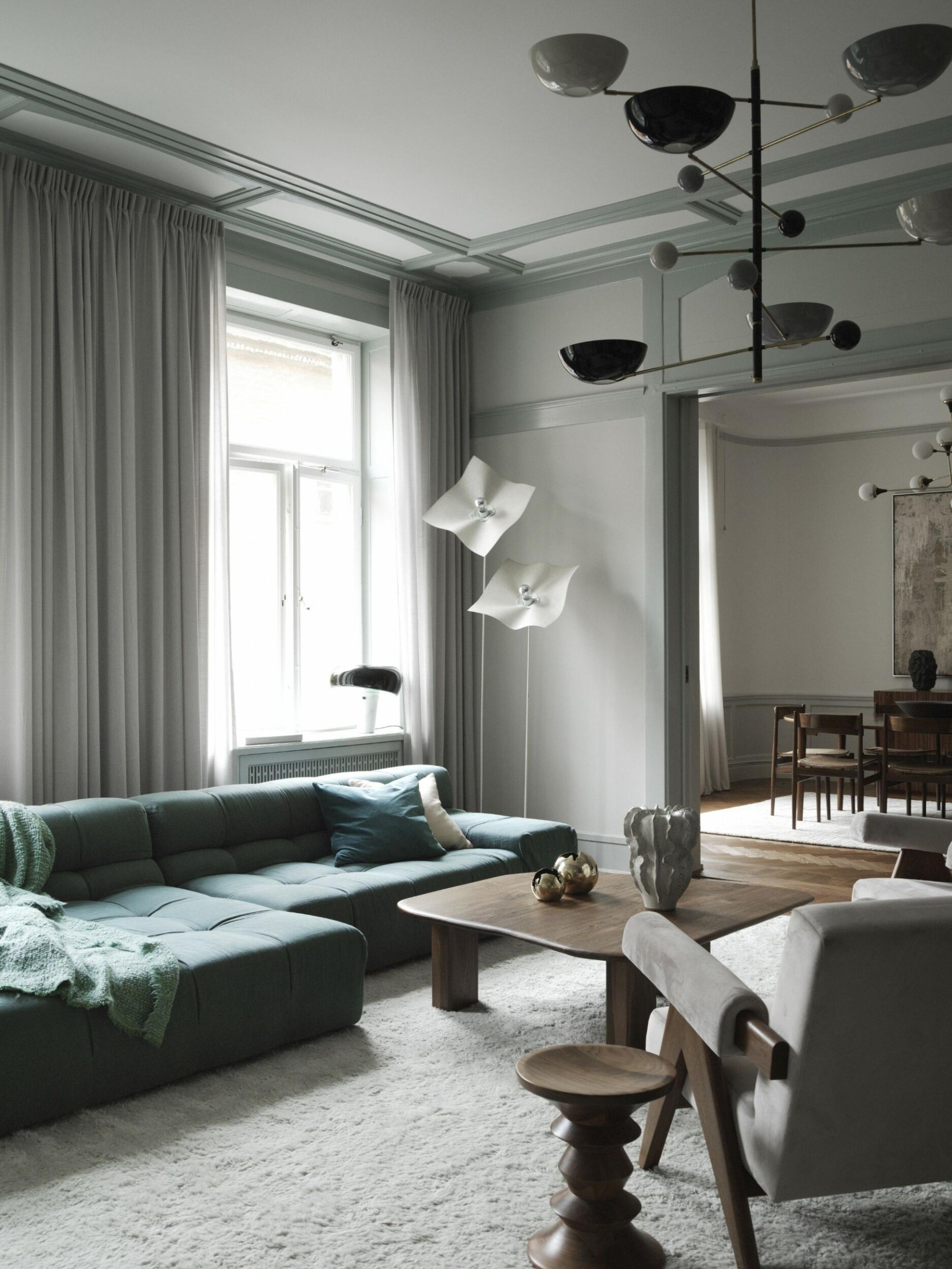
The rug is the piece people get wrong, and Nordström says so: "Many people make the mistake of buying rugs that are too small. The rug has to go a good way under the sofa and the other seats in the same area." In Karhard's room the round rug sits inside the curve of the sofa and marks out the conversation, which is the job a rug is for. A small rug floating in front of a sofa only marks out the walkway to the television.
A room of rooms, lit for the evening
The last move is subdivision. The open-plan living room was one big volume with the ceiling light on. The ones I keep saving have corners.
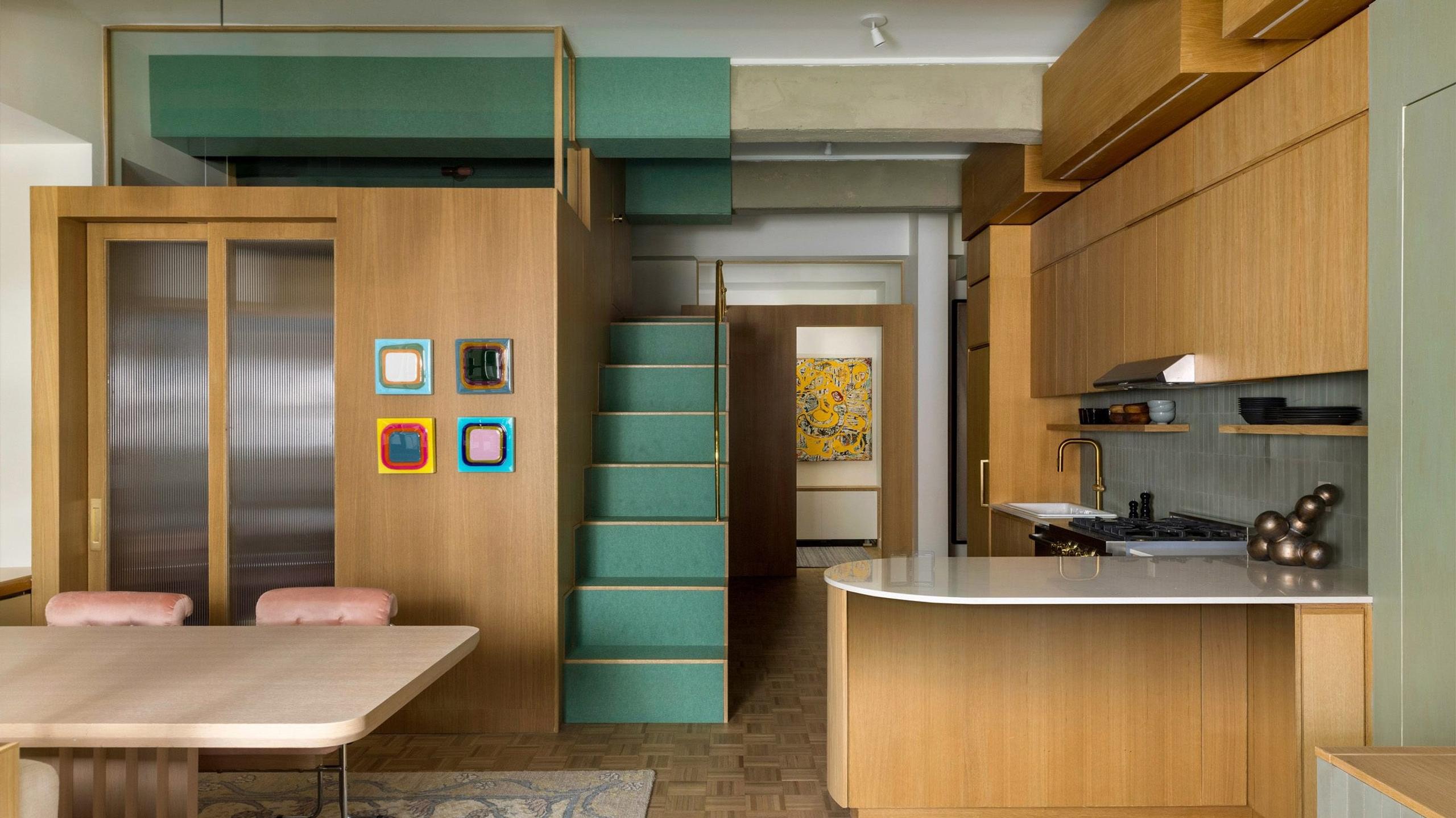
In New York's West Village, Studio Vural renovated a 139-square-metre loft in a 1920s former herring canning factory and describes the plan as "pods in a box": a home office, a reading loft up felt-covered stairs and a sleeping nook, all wrapped in oak inside the open shell. The brief was a home for hosting parties. The previous version, Selim Vural told Dezeen, had smoky mirrored walls and "a small koi pond in a corner of the living room".
Smaller versions of the idea cost almost nothing. Wahlström Walter puts a daybed beside the kitchen and dining table, because it stretches the living room and makes the rooms flow. Marcelis's curtain turns half a loft into a den at night. Beside her 1967 Pierre Paulin Osaka sofa stands a 2.96-metre lava lamp she designed for Mathmos. The evening room is lit in pools, low, close to the people, and the big overhead light stays off.
What it asks of the people planning the room
For anyone commissioning a living room, in a home, a show flat or a hotel suite, the order of the brief changes. Seating first, the screen last. Decide where the cables go before anyone draws the joinery. Budget for the rug as furniture, sized to run under every seat. Leave money for small tables, because a guest with nowhere to put a glass down does not stay long.
The useful questions to put to a studio change too. What does everyone face when the television is off? Can the sofa leave the wall? Where does the screen live at eleven in the morning?
On Lidingö, the television still has a room. It is the one next door, with a big sofa, a bit of floor and a screen on the wall, which is more or less the living room most of us grew up in. It just has a door now.
Written by

Poppy Leverentz
Head of Industry Engagement & Insights, Yntra Studio
Poppy tracks the rooms, studios and openings shaping interiors and architecture, from Stockholm outward. Field notes every week.
Sources
- 1Residence, Frida Lagerblad, "Projekt vardagsrum: inredningsexperterna berättar", 12 October 2026. residencemagazine.se/inredning/projekt-vardagsrum-inredningsexperterna-berattar/11649493
- 2Dezeen, Jon Astbury, "Studio Razavi adds circular conversation pit to coastal French home", 28 March 2026. dezeen.com/2026/03/28/studio-razavi-seaside-house-cap-ferret/
- 3Dezeen, Nat Barker, "'We want to be a global furniture brand, but not in the Hay or Muuto or Vitra area of expensiveness' says Omhu CEO", 6 October 2026. dezeen.com/2026/10/06/omhu-teddy-sofa-interview/
- 4Dezeen, Jane Englefield, "Berlin apartment designed to be 'Berghain in a homely context'", 23 January 2026. dezeen.com/2026/01/23/berlin-apartment-berghain-studio-karhard/
- 5Interior Daily, "Cattelan Italia unveils curvy module for Craig sofa at Salone del Mobile.Milano 2026", 27 February 2026. interiordaily.com/article/9814992/cattelan-italia-unveils-curvy-module-for-craig-sofa-at-salone-del-mobile-milano-2026/
- 6Dezeen Showroom, "Soft Stone sofa by Gabriel Tan for ClassiCon", 16 April 2026. dezeen.com/2026/04/16/soft-stone-sofa-gabriel-tan-classicon-dezeen-showroom/
- 7Dezeen, Jane Englefield, "Sabine Marcelis's Rotterdam loft apartment is 'forever evolving' with her life", 30 June 2026. dezeen.com/2026/06/30/sabine-marcelis-rotterdam-loft-apartment/
- 8Dezeen, Cajsa Carlson, "Eight inspiring homes with bookmaxxed interiors", 27 June 2026. dezeen.com/2026/06/27/homes-bookmaxxed-interiors-lookbooks/
- 9Dezeen, Dan Howarth, "New York loft renovation by Studio Vural comprises 'pods in a box'", 2 August 2026. dezeen.com/2026/08/02/studio-vural-herring-factory-loft-renovation-west-village-new-york/
Image credits
- 1Photo: Robert Rieger, via Dezeen. Source: dezeen.com/2026/01/23/berlin-apartment-berghain-studio-karhard/
- 2Photo: Simone Bossi, via Dezeen. Source: dezeen.com/2026/03/28/studio-razavi-seaside-house-cap-ferret/
- 3Photo: Idha Lindhag, via Residence. Source: residencemagazine.se/inredning/projekt-vardagsrum-inredningsexperterna-berattar/11649493
- 4Photo: Letizia Cigliutti, via Dezeen. Source: dezeen.com/2026/06/30/sabine-marcelis-rotterdam-loft-apartment/
- 5Photo: Ragnar Ómarsson, via Residence. Source: residencemagazine.se/inredning/projekt-vardagsrum-inredningsexperterna-berattar/11649493
- 6Photo: Kate Glicksberg, via Dezeen. Source: dezeen.com/2026/08/02/studio-vural-herring-factory-loft-renovation-west-village-new-york/